


Page 197 - Edited - Webster HEAD AND NECK - part 1
P. 197
HN 163
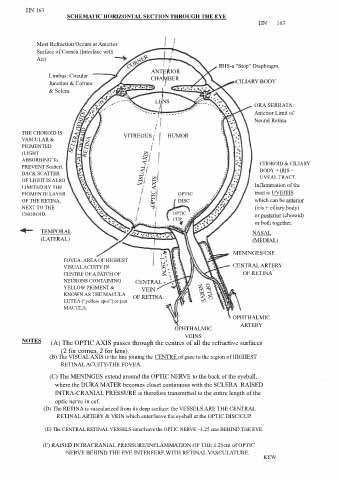
                         SCHEMATIC HORIZONTAL SECTION THROUGH THE EYE
                                                                                            HN    163


              Most Refraction Occurs at Anterior

              Surface of Cornea (Interface with
              Air)
                                                                              IRIS-a “Stop” Diaphragm.
                                                      ANTERIOR
                  Limbus: Circular                      CHAMBER
                  Junction & Cornea                                                 CILIARY BODY
                  & Sclera.

                                                        LENS
                                                                                          ORA SERRATA:
                                                                                          Anterior Limit of
                                                                                          Neural Retina.
         THE CHOROID IS                     VITREOUS           HUMOR
         VASCULAR &
         PIGMENTED
         (LIGHT
         ABSORBING To                                                                       CHOROID & CILIARY
         PREVENT Scatter).                                                                  BODY + IRIS =
         BACK SCATTER                                                                       UVEAL TRACT.
         OF LIGHT IS ALSO
         LIMITED BY THE                                                                   Inflammation of the
         PIGMENTE LAYER                                         OPTIC                     tract is UVEITIS
         OF THE RETINA,                                         DISC                      which can be anterior
         NEXT TO THE                                                                      (iris + ciliary body)
         CHOROID.                                             OPTIC                       or posterior (choroid)
                                                              CUP
                                                                                          or both together.
               TEMPORAL                                                                   NASAL
               (LATERAL)                                                                  (MEDIAL)

                                                                                   MENINGES/CSF.
                       FOVEA: AREA OF HIGHEST
                       VISUAL ACUITY IN                                            CENTRAL ARTERY
                       CENTRE OF A PATCH OF                                           OF RETINA
                       NEURONS CONTAINING        CENTRAL
                       YELLOW PIGMENT &            VEIN
                       KNOWN AS THE MACULA      OF RETINA.
                       LUTEA (“yellow spot”) or just
                       MACULA.
                                                                                   OPHTHALMIC
                                                                                     ARTERY
                                                              OPHTHALMIC
                                                                  VEINS
         NOTES     (A) The OPTIC AXIS passes through the centres of all the refractive surfaces

                      (2 for cornea, 2 for lens).
                  (B) The VISUAL AXIS is the line joining the CENTRE of gaze to the region of HIGHEST
                      RETINAL ACUITY-THE FOVEA.

                  (C) The MENINGES extend around the OPTIC NERVE to the back of the eyeball,
                    where the DURA MATER becomes closet continuous with the SCLERA. RAISED
                    INTRA-CRANIAL PRESSURE is therefore transmitted to the entire length of the
                    optic nerve in csf.
                (D) The RETINA is vascularized from its deep surface: the VESSELS ARE THE CENTRAL
                     RETINAL ARTERY & VEIN which enter/leave the eyeball at the OPTIC DISC/CUP.

                 (E) The CENTRAL RETINAL VESSELS enter/leave the OPTIC NERVE ~1.25 cms BEHIND THE EYE.


                (F) RAISED INTRACRANIAL PRESSURE/INFLAMMATION OF THE 1.25cm of OPTIC
                        NERVE BEHIND THE EYE INTERFERE WITH RETINAL VASCULATURE.
                                                                                             KEW
                                                                                                      .

