


Page 82 - Edited - Webster HEAD AND NECK - part 2-Merge PDF
P. 82
HN 274

                                              THE GLOTTIS AND VOCAL FOLDS

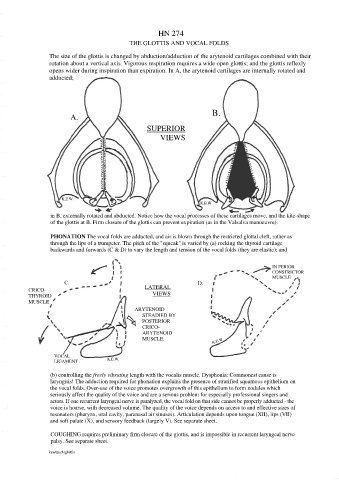
                  The size of the glottis is changed by abduction/adduction of the arytenoid cartilages combined with their
                  rotation about a vertical axis. Vigorous respiration requires a wide open glottis; and the glottis reflexly
                  opens wider during inspiration than expiration. In A, the arytenoid cartilages are internally rotated and
                  adducted;


                                                                            B.
                          A.
                                                     SUPERIOR
                                                         VIEWS


                       K.E.W.
                                                                       K.E.W.
                   in B, externally rotated and abducted. Notice how the vocal processes of these cartilages move, and the kite-shape
                   of the glottis at B. Firm closure of the glottis can prevent expiration (as in the Valsalva manoeuvre).

                   PHONATION The vocal folds are adducted, and air is blown through the restricted glottal cleft, rather as
                   through the lips of a trumpeter. The pitch of the "squeak" is varied by (a) rocking the thyroid cartilage
                   backwards and forwards (C & D) to vary the length and tension of the vocal folds (they are elastic); and


                                                                                                 IN FERIOR
                                                                                                 CONSTRICTOR
                                                                                                 MUSCLE
                        C.                                            D.
           CRICO-                                   LATERAL
           THYROID                                     VIEWS
           MUSCLE
                                                ARYTENOID
                                                   STEADIED BY
                                                   POSTERIOR
                                                   CRICO-
                                                   ARYTENOID
                                                   MUSCLE.


                    VOCAL
                    LIGAMENT           K.E.W.

                   (b) controlling the freely vibrating length with the vocalis muscle. Dysphonia: Commonest cause is
                   laryngitis! The adduction required for phonation explains the presence of stratified squamous epithelium on
                   the vocal folds. Over-use of the voice promotes overgrowth of this epithelium to form nodules which
                   seriously affect the quality of the voice and are a serious problem for especially professional singers and
                   actors. If one recurrent laryngeal nerve is paralyzed, the vocal fold on that side cannot be properly adducted - the
                   voice is hoarse, with decreased volume. The quality of the voice depends on access to and effective sizes of
                   resonators (pharynx, oral cavity, paranasal air sinuses). Articulation depends upon tongue (XII), lips (VII)
                   and soft palate (X), and sensory feedback (largely V). See separate sheet.
                   COUGHING requires preliminary firm closure of the glottis, and is impossible in recurrent laryngeal nerve
                   palsy. See separate sheet.

                  kewteach\glottis

