


Page 95 - Edited - Webster HEAD AND NECK - part 2-Merge PDF
P. 95
HN     288

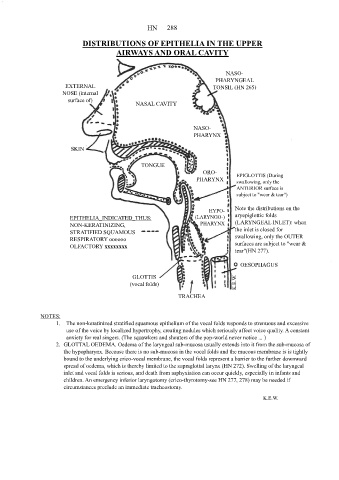
                              DISTRIBUTIONS OF EPITHELIA IN THE UPPER
                                          AIRWAYS AND ORAL CAVITY


                                                                                NASO-
                                                                             PHARYNGEAL
                        EXTERNAL                                            TONSIL (HN 265)
                       NOSE (internal
                         surface of)             NASAL CAVITY


                                                                     NASO-
                                                                     PHARYNX

                          SKIN

                                                   TONGUE
                                                                        ORO-        EPIGLOTTIS (During
                                                                      PHARYNX       swallowing, only the
                                                                                    ANTERIOR surface is
                                                                                    subject to "wear & tear")

                                                                                    Note the distributions on the
                                                                          HYPO-
                          EPITHELIA_INDICATED_THUS:                  (LARYNGO-)     aryepiglottic folds
                          NON-KERATINIZING,                            PHARYNX      (LARYNGEAL INLET): when
                          STRATIFIED SQUAMOUS                                       the inlet is closed for
                          RESPIRATORY oooooo                                        swallowing, only the OUTER
                          OLFACTORY xxxxxxxx                                        surfaces are subject to "wear &
                                                                                    tear"(HN 277).

                                                                                       OESOPHAGUS

                                                GLOTTIS                             .
                                               (vocal folds)                        K.E.W

                                                                TRACHEA

               NOTES:
                     1.   The non-keratinized stratified squamous epithelium of the vocal folds responds to strenuous and excessive
                        use of the voice by localized hypertrophy, creating nodules which seriously affect voice quality. A constant
                        anxiety for real singers. (The squawkers and shouters of the pop-world never notice ... )
                     2.  GLOTTAL OEDEMA. Oedema of the laryngeal sub-mucosa usually extends into it from the sub-mucosa of
                       the hypopharynx. Because there is no sub-mucosa in the vocal folds and the mucous membrane is is tightly
                       bound to the underlying crico-vocal membrane, the vocal folds represent a barrier to the further downward
                       spread of oedema, which is thereby limited to the supraglottal larynx (HN 272). Swelling of the laryngeal
                       inlet and vocal folds is serious, and death from asphyxiation can occur quickly, especially in infants and
                       children. An emergency inferior laryngotomy (crico-thyrotomy-see HN 277, 278) may be needed if
                       circumstances preclude an immediate tracheostomy.

                                                                                             K.E.W .

