


Page 96 - Edited - Webster HEAD AND NECK - part 2-Merge PDF
P. 96
HN 289
                                              LARYNGOSCOPY

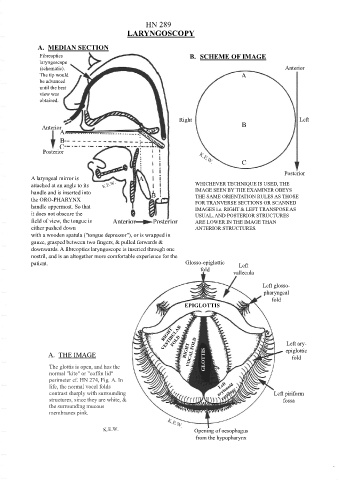
              A.  MEDIAN SECTION
               Fibreoptics                                          B.  SCHEME OF IMAGE
               laryngoscope
               (schematic).                                                                          Anterior
               The tip would                                                          A
               be advanced
               until the best
               view was
               obtained.


                                                                Right                                     Left
                Anterior                                                              B
                       A
                         B
                      C
                Posterior

                                                                                      C
                                                                                                     Posterior
            A laryngeal mirror is                 A
            attached at an angle to its                               WHICHEVER TECHNIQUE IS USED, THE
            handle and is inserted into               B               IMAGE SEEN BY THE EXAMINER OBEYS
            the ORO-PHARYNX                              C            THE SAME ORIENTATION RULES AS THOSE
                                                                      FOR TRANVERSE SECTIONS OR SCANNED
            handle uppermost. So that                                 IMAGES i.e. RIGHT & LEFT TRANSPOSE AS
            it does not obscure the                                   USUAL, AND POSTERIOR STRUCTURES
            field of view, the tongue is   Anterior          Posterior   ARE LOWER IN THE IMAGE THAN
            either pushed down                                        ANTERIOR STRUCTURES.
            with a wooden spatula ("tongue depressor"), or is wrapped in
            gauze, grasped between two fingers, & pulled forwards &
            downwards. A fibreoptics laryngoscope is inserted through one
            nostril, and is an altogether more comfortable experience for the
            patient.                                              Glosso-epiglottic   Left
                                                                       fold        vallecula


                                                                                             Left glosso-
                                                                                              pharyngeal
                                                                                                fold
                                                                  EPIGLOTTIS


                                                                                                      Left ary-

                  A.  THE IMAGE                                                                      epiglottic
                                                                                                        fold
                                                                         GLOTTIS
                  The glottis is open, and has the
                  normal "kite" or "coffin lid"
                  perimeter cf. HN 274, Fig. A. In
                  life, the normal vocal folds
                  contrast sharply with surrounding                                              Left piriform
                  structures, since they are white, &                                               fossa
                  the surrounding mucous
                  membranes pink.


                                                                     Opening of oesophagus
                                                                      from the hypopharynx

