


Page 60 - Edited - Webster HEAD AND NECK - part 2-Merge PDF
P. 60
ΗΝ 254
                                                          THE PHARYNX

                         "Everything could be very nicely arranged, if only we could do things twice over." (Goethe-
                  Gemischte Epigrammen).


                         I'm not sure I agree - sounds too much like "the triumph of hope over experience" (Johnson,
                  as  a  twice  married  man,  should  have  known).  However,  the  demiurge,  creatorix  mundi,
                  contemplating the pharynx from the Celestial Retirement Home, may well concur:


                                                                             PITUITARY FOSSA
                SCHEMATIC
                MEDIAN                                                       BODY OF SPHENOID
                SECTION                            NASAL
                                                                              BASIOCCIPITAL
                                                                  P

                                                    CAVITY


                                                                   H
                        PALATE                                     A
                                                   TONGUE          R


                                                                                     BODIES OF
                         MANDIBLE                                                    CERVICAL
                         (cut)                                                       VERTEBRAE
                                  HYOID
                                  (cut)                            Y
                                                                   N
                                  EPIGLOTTIS (cut)                 X
                                    THYROID
                  OF                CARTILAGE (cut)
                  LARYNX
                  (CAVITY OF                                                          OESOPHAGUS
                  LARYNX IS        CRICOID
                  STIPPLED)        CARTILAGE
                                   (cut).                                    K.E.W.
                                            TRACHEA


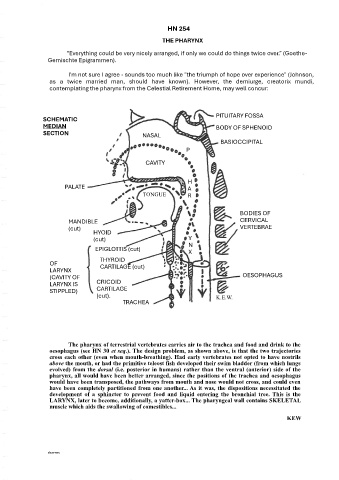
                         The pharynx of terrestrial vertebrates carries air to the trachea and food and drink to the
                  oesophagus (see HN 30 et seq.). The design problem, as shown above, is that the two trajectories
                  cross each other (even when mouth-breathing). Had early vertebrates not opted to have nostrils
                  above the mouth, or had the primitive teleost fish developed their swim bladder (from which lungs
                  evolved) from the dorsal (i.e. posterior in humans) rather than the ventral (anterior) side of the
                  pharynx, all would have been better arranged, since the positions of the trachea and oesophagus
                  would have been transposed, the pathways from mouth and nose would not cross, and could even
                  have been completely partitioned from one another... As it was, the dispositions necessitated the
                  development  of  a  sphincter  to  prevent  food  and  liquid  entering  the  bronchial  tree. This  is  the
                  LARYNX, later to become, additionally, a yatter-box... The pharyngeal wall contains SKELETAL
                  muscle which aids the swallowing of comestibles...

                                                                                                      KEW


                  charvnx

